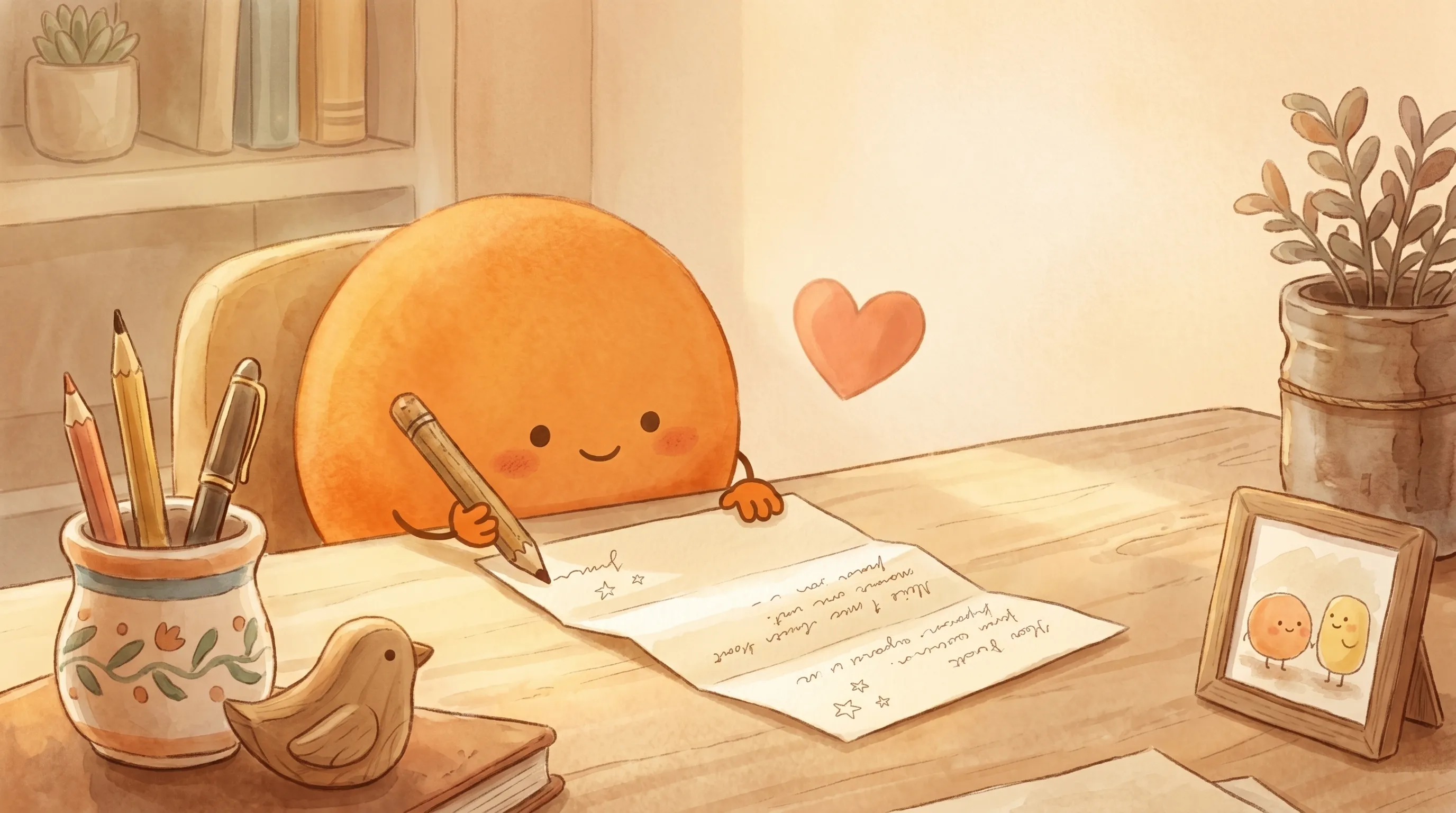
Nobody needs a poem. There are faster ways to say everything a poem says. And still, when someone copies one out by hand and leaves it where you'll find it, something in the chest goes quiet.
That's because the poem itself is only half the gift. The other half is the time it announces. Someone sat with this, for you.
Why a poem still works
Texts are fast, and she knows it. A poem is slow on purpose. It says: this feeling was worth more than my usual speed.
It doesn't matter whether the lines are borrowed from a dead poet or built by you at the kitchen table. What matters is the choosing. Out of everything ever written, you picked the lines that sound like her. That choice is the love letter; the poem is just its envelope.
The famous ones, and why they last
These four have been handed between lovers for over a century. They survived because they're true, and they're all old enough to belong to everyone now.
"How do I love thee? Let me count the ways." Elizabeth Barrett Browning wrote her sonnets during a real, secret courtship; her husband-to-be's first letter to her opened with how much he loved her poems. Give this one when the feeling is the everyday kind: "I love thee to the level of every day's most quiet need, by sun and candle-light."
"O my Luve is like a red, red rose, that's newly sprung in June." Robert Burns, 1794, and still the gold standard for uncomplicated adoration. The second verse is the one to copy out: "And I will luve thee still, my dear, till a' the seas gang dry."
"She walks in beauty, like the night of cloudless climes and starry skies." Byron wrote it after seeing a woman once, at a party. It's the poem for the early days, when she still surprises you by entering a room. Which, in the good versions of this story, never fully stops.
"I have spread my dreams under your feet; tread softly because you tread on my dreams." The closing lines of W. B. Yeats's "He Wishes for the Cloths of Heaven", eight lines long and the most quietly vulnerable thing on this page. For the moment you're handing her something fragile and you both know it.
Short poems that fit in a note
Whole poems, small enough to copy onto a card without your hand cramping.
Sara Teasdale's "I Am Not Yours" opens: "I am not yours, not lost in you, not lost, although I long to be lost as a candle lit at noon, lost as a snowflake in the sea." It's about wanting to fall completely while still being your own person, which makes it the rare love poem that respects her on the way in.
Christina Rossetti begins a sonnet "I loved you first: but afterwards your love, outsoaring mine, sang such a loftier song." A poem for long couples: a gentle argument about who loves whom more, ending in a draw.
And Shakespeare's Sonnet 116 carries the line built for hard seasons: "Love is not love which alters when it alteration finds." Less pretty than the others, more load-bearing.

Be one of the first couples in the nest
We're quietly making something small and warm for the two of you. Leave your email and you're one of our founding couples: first in when it opens, with a little thank-you we'll keep just for you.
No spam, no newsletter. One good email when it’s ready.
Writing her four lines yourself
Here's the secret the famous poets would confirm: a wobbly poem written about her beats a perfect poem written about nobody. You only need four lines, and there's a shape that almost cannot fail.
Line one: a real detail you've noticed about her. Line two: what that detail does to you. Line three: a small confession. Line four: land somewhere soft. No rhyme required. Rhyme is the first thing to sacrifice and the last thing she'll miss.
It comes out like this:
"You read the last page of books first,
and somehow I find that brave.
I've stopped wondering how my story ends.
It ends wherever you are."
Or this:
"There's a version of every evening
where I don't hear you singing in the kitchen.
I've seen it. It's fine.
I never want it."
A wobbly poem about her beats a perfect poem about nobody.
How to give her a poem
Quietly. A poem read aloud over a planned candlelit dinner has nowhere to hide; a poem found folded in her bag at lunch gets to do its work in private, which is where poems are strongest.
Handwrite it, even if your handwriting embarrasses you. Especially then. The crossed-out word is evidence of the time, and the time is the gift. If distance is part of your story, a photographed handwritten poem sent at the right hour carries surprisingly well across any number of kilometers.
If four lines still feels like more than the moment needs, start smaller: a single good line counts too, and we keep a page of short love quotes for exactly that. The note-sized version of all of this lives in our love notes guide.
What people ask
What is the most romantic poem for her?
Elizabeth Barrett Browning's Sonnet 43, 'How do I love thee?', is the consensus answer and earns it: it was written inside a real love story, not about an imaginary muse. For something less famous and more disarming, Yeats's 'Cloths of Heaven' in eight lines.
How do I write a love poem for my girlfriend?
Four lines: one real detail you've noticed about her, what it does to you, one small confession, one soft landing. Skip rhyme unless it arrives on its own. The detail is what makes it hers; everything else is decoration.
What is a short love poem for her?
Sara Teasdale's 'I Am Not Yours' and the closing lines of Yeats's 'Cloths of Heaven' both fit on a card. Or write the four-line kind yourself; short original verse outweighs long borrowed verse almost every time.
Do girls actually like love poems?
What lands isn't the poetry, it's the evidence of time and attention, which a poem happens to carry well. A borrowed poem chosen precisely, or four wobbly lines written about her specifically, both pass that test. A generic poem pasted from a list does not.
Be one of the first couples in the nest
Something small for the two of you is on the way. The first couples to join become founding couples: in before anyone else, with a little thank-you saved for when it opens.
No spam, no newsletter. One good email when it’s ready.