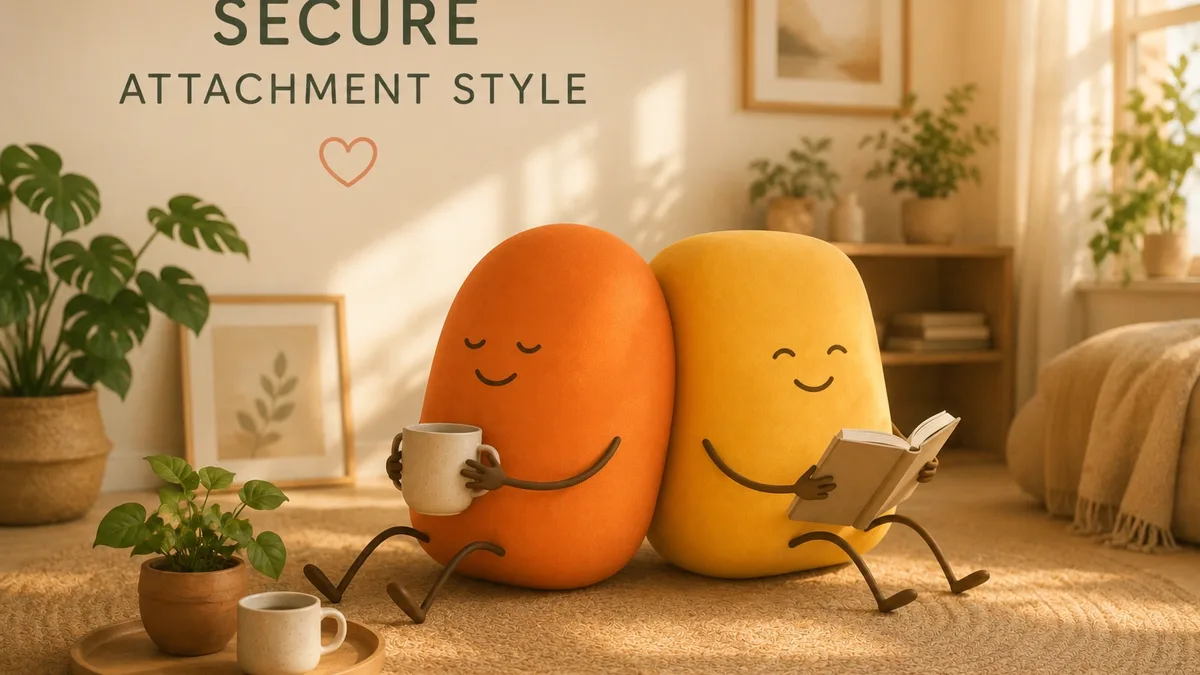
Every article about attachment styles spends its word count on the struggling ones. Anxious gets the sympathy, avoidant gets the warnings, disorganized gets the concern.
Secure gets a paragraph. "About half of people. Comfortable with closeness. Moving on."
Which is a strange way to treat the destination. Secure attachment is what the other styles are trying to reach, what therapy quietly aims at, and what your relationship is building or eroding every ordinary week. It deserves the full tour.
What secure attachment actually looks like
Watch a securely attached couple on a random Tuesday and the first thing you notice is how little you notice.
One says "that comment at dinner stung a bit." The other says "oh, I didn't hear it that way, tell me." Four sentences, no courtroom. One goes away for a weekend with friends; the other waters the plants and misses them mildly. A text goes unanswered for three hours and is assumed to mean a long meeting, because it usually does.
Underneath the calm is one load-bearing belief: love holds, even when it's having a bad day. From that single assumption, everything else follows. Complaints can be voiced while they're small. Space isn't a threat. Reassurance can be requested without shame and given without scorekeeping.
To be clear about what secure is not: it is not the absence of jealousy, neediness, or fear. Secure people feel all of it. The difference is plumbing. The feeling gets named, spoken, and drained, instead of pooling somewhere structural.
Where it comes from
The standard origin, per decades of research summarized by the Cleveland Clinic, is consistent early care: comfort that came reliably when needed. Not perfect parenting, just predictable-enough warmth. The child learns that reaching works, and stops needing to monitor or armor.
Around half to 60 percent of people got some version of that start. Which leaves a very large group who did not, reading this paragraph with the familiar sinking feeling of having missed a boat in childhood.
You did not miss the boat. That is the next section, and it is the one worth the price of admission.
Earned security: the part that should be famous
Attachment researchers have a category for people who score secure as adults despite difficult childhoods: earned security. Not granted, not lucky. Earned.
It is one of the most replicated hopeful findings in the field, and it dismantles the fatalism that attachment content often sells. The expectations you built at four were rational conclusions from the evidence available at four. Adult life keeps submitting new evidence. A steady partner, a long friendship, a good therapist, even a calm decade: the system quietly re-runs the numbers.
Security is not a childhood inheritance. It is a habit of expectation, and habits retrain.

People who earn security usually cannot name the day it happened. They just notice, one year, that the unanswered text is boring now. That they asked for help without drafting the request first. The alarm did not get argued away. It got out-evidenced.

Be one of the first couples in the nest
We're quietly making something small and warm for the two of you. Leave your email and you're one of our founding couples: first in when it opens, with a little thank-you we'll keep just for you.
No spam, no newsletter. One good email when it’s ready.
How to build it, from any starting point
Be reliable in small, boring ways. Security is built from kept micro-promises: the call that comes when promised, the "home safe" text, plans that survive contact with a better offer. Each one is a brick. Grand gestures are decoration; bricks are structure.
Repair fast and out loud. Secure couples are not the ones who never snap at each other. They are the ones where "I was sharp earlier, that wasn't about you" arrives the same evening. Fast repair teaches both nervous systems that rupture is survivable, which is the entire lesson security rests on. It is also the core habit in our guide to what a healthy relationship actually looks like.
Say feelings while they are still small. The secure move is radical only in its timing: name the thing at size one instead of size nine. "I felt a bit left out tonight" costs almost nothing. The same sentence after three weeks of marinating costs an evening.
Let your partner's style teach you what steadiness they need. An anxious partner is steadied by consistency, an avoidant one by unpunished space. Providing it is not coddling; it is how one person's calm becomes two people's. The mechanics are in our attachment styles guide.
Collect your own evidence. When closeness goes well, register it. The night you asked for reassurance and got it. The space you took that nobody punished. Earned security is mostly bookkeeping: the good data only counts if somebody writes it down inside you.
For your next conversation
- "What's one small promise I keep that matters to you?"
- "When did you last feel completely at ease with me, no monitoring, no managing?"
- "What would make it easier to tell me things while they're still small?"
Secure attachment will never be interesting content. There is no spiral to narrate, no wall to break down, nothing to diagnose at 2am.
There is just a quiet assumption, built brick by boring brick, that the person you love will still be there after the bad day, the long meeting, and the unanswered text.
It is the least dramatic thing two people can build. Build it anyway.
Common questions
What does secure attachment look like in a relationship?
Boring, in the best way. Disagreements that stay about the topic. Space taken without panic and closeness given without strings. Saying "that hurt" the same day it happened. The defining feature is quick recovery: upsets happen, and the system returns to calm because it expects love to hold.
Can I become securely attached as an adult?
Yes. Researchers call it earned security, and it is one of the most hopeful findings in the field. People who started anxious, avoidant, or disorganized move toward secure through steady relationships, therapy, and accumulated evidence that closeness is safe. The style is a habit of expectation, and habits retrain.
Can a secure person date an insecure one?
It is one of the best-studied paths to earned security. A steady partner who doesn't punish space or vanish under pursuit gives an insecure system thousands of small corrective experiences. It asks patience of the secure partner, and it works in both directions: living alongside steadiness is how steadiness gets learned.
Is secure attachment the same as never feeling jealous or needy?
No. Secure people feel jealousy, neediness, and doubt like everyone else. The difference is what happens next: the feeling gets named and discussed instead of managed alone or weaponized. Security is not the absence of hard feelings; it is a reliable way through them.
Be one of the first couples in the nest
Something small for the two of you is on the way. The first couples to join become founding couples: in before anyone else, with a little thank-you saved for when it opens.
No spam, no newsletter. One good email when it’s ready.